
Practical Guide to 18th Century Drumming
by Ron Aylor
Click on the Drum Tacks to return to Contents.
Lesson Five: The "Numbered" RollsHaving mastered the Long Roll, you should find the remaining drum rolls to be quite simple. Surely you will agree that the Long Roll could indeed continue indefinitely. This is not the case with the "numbered" rolls. As their names imply, they are of definite duration. The most common being the 5, 7, 9, 10, and the 11-Stroke Roll. Other numbered rolls to be considered in this genre of drumming would be the 13, 15, and the 17-Stoke Roll. All of the "numbered" rolls can be found within the Long Roll.
If you will recall from lesson one, ties combine two or more notes to create a single longer note value. Usually when performing tied notes, only the first note is articulated and sustained for the particular value. In drumming, we sustain the sound over these longer note values by way of the roll. Although the sound of the last stroke of a roll may not "carry" for the entire note valve indicated we must allow for its value before continuing.
It is possible to have rolls of virtually any number of strokes. Usually we consider any roll over 17-Strokes to be a Long Roll. Below are examples of different tied note values along with their corresponding rolls in simple time.

Remember that in compound time the roll is performed on the division of the beat. Below are examples of different tied note values along with their corresponding rolls in compound time

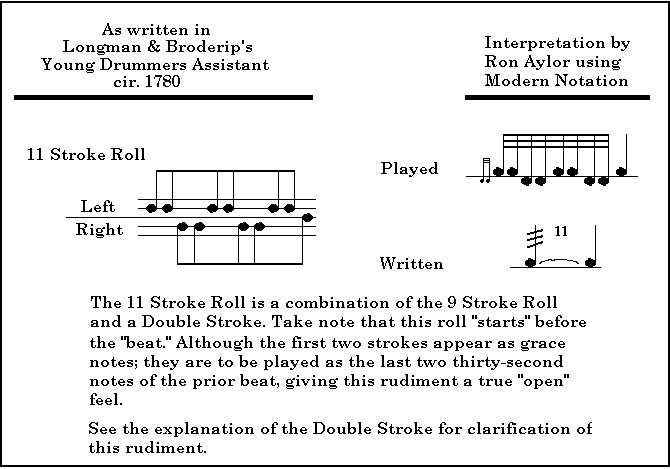
As you may have noticed the rolls illustrated above all started "on the beat." Below are examples of "numbered" rolls in simple time that start "off the beat." Please refer to lesson 2 if you need to refresh your memory on how to "count" these off-beat rolls.

Below are examples of "numbered" rolls in compound time that start "off the beat."

Practice these Rolls by starting out at a very slow tempo. Gradually increase the tempo to normal "marching" tempo. Take care to maintain a balanced sound from each hand, and even spacing of the strokes. Before you begin, determine in what meter you are playing. Remembering that in simple time the Rolls are played as thirty-second notes and that in compound time they are played as sixteenth notes. Always maintain the "counting" as described in lesson two.


 Back to Contents
©copyright 2001 Ron Aylor